
Sunset Rubdown: Random Spirit Lover
Spencer Krug's manic and unbelievably dense second album reveals itself as a masterwork of imagination, a fantastical and gonzo fever dream that only he could have created

Twelve years ago I had a blog where I wrote music reviews about albums I loved and my friend illustrated them. The blog is dead but I’m reposting the reviews. It was called You Should Listen to This. The first three posts in this series can be found here, here, and here.
In these days of mp3s and iPods, it’s rare to find artists who even care about the album format anymore. Most artists are lucky if they can string together a few good singles, let alone a full album of worthwhile material. A shrinking contingent of musicians and music consumers, however, still see the album as the proper format to experience music. A carefully crafted album is so much more than the sum of its individual parts. Listening to it is a very real emotional experience. The experience can be exciting, exhausting, depressing, jubilant, terrifying. Great albums succeed in forcing the listener into the headspace envisioned by the artist, a carefully calculated and crafted alternate reality that is realized and reinforced through successive listening of individually unique parts. Every element of the album, the music, the arrangements, the vocals, serves to convey one unifying theme.
This is a difficult feat to achieve, but when everything clicks, the result is a truly singular and rewarding experience. Examples of these types of albums litter music history, and music listeners have lively (but mostly pointless) debates over which are the best. For my money, as an album, Sunset Rubdown’s magnificent Random Spirit Lover stands toe to toe with any album from any decade in terms of its inventiveness, imagination, thematic, lyrical, and musical complexity, and overall success in creating a singular, strange, and unique musical aesthetic and experience.
Sunset Rubdown are the maniacal ravings of the prolific Montreal-based musician Spencer Krug. Most who are familiar with him will know him as the more vocally and musically manic singer/songwriter in the now defunct Montreal band Wolf Parade, where Krug offered a refreshing insanity to counter Dan Boeckner’s more straightforward and less inspired guitar rock. Krug is restlessly creative, being involved in over twenty different musical releases with at least six bands since 2002, but he attained “mainstream” indie success and acclaim with the release of Wolf Parade’s debut Apologies to the Queen Mary (a reference to an incident that resulted in the bands’ dismissal from the ocean liner) in 2005. That album was a masterful blend of contemporary off-kilter guitar rock with lush and atmospheric synthesizers and keyboards.
Krug’s contributions were hands-down the best parts of Apologies, his experimental, ballooning soundscapes and feverish yelping vocals cohering into something wondrously imaginative. Eight months later, Krug released his official, full band debut as Sunset Rubdown, Shut Up I’m Dreaming. Free from the constraints of the more “pop” oriented Wolf Parade, Krug was free to indulge in his wildest and most gonzo experimental impulses. Shut Up I’m Dreaming is an incredible blend of blown out glam rock freakouts, tender piano and acoustic guitar balladry, creepy and unsettling carnivalesque synthesizer kaleidoscopes (my brother once aptly called the album “vampire circus music”), and Krug’s abstract, impressionistic lyrical musings. To a certain segment of the indie music population who were already enamored, this writer included, it cemented Krug’s place as one of the most inventive, imaginative songwriters of his generation.
The highly anticipated follow-up, Random Spirit Lover, leaked four months ahead of its official release. By the time it was released, I had been listening to it non-stop for those four months. It was my album of the year for 2007 by a light year, nothing even came close. It’s at the top of my list of best albums of that decade, and close to the top of my list of favorite albums of all time. Taking the musical template established on Shut Up I’m Dreaming and elevating it in every conceivable way, Random Spirit Lover is Krug’s masterpiece. Twelve musically and thematically interconnected songs and one hour of music so dense that four months of listening didn’t even begin to scratch the surface, Random Spirit Lover is full of bizarre and moving lyrical imagery, unpredictable and challenging song structures, and bewilderingly complex arrangements, all held together by Krug’s signature vocal yelp.
The music on Random Spirit Lover is comprised of layers upon layers of sinewy, serpentine guitars, pounding and arpeggiated keyboards and organs, icy synths, and bombastic drums. The arrangements are highlighted by accordion, melodica, glockenspiel, and other embellishments. Because of the layers, in contrast to the relatively more spacious Shut Up I’m Dreaming, the album feels incredibly, almost unbelievably dense. This density makes it tough to crack initially, but all the more rewarding upon repeat listens. The layered approach to recording the album also results in incredibly complex song structures and arrangements. There are no verses and choruses to be found here, nothing to grasp onto to stave off the astounding, disorienting, consuming delirium.
Album opener “The Mending of the Gown” charges out of the gate with Jordan Robson-Cramer’s searing guitar lead, playing a complex descending riff. Next come Krug’s keys, followed by tambourine, then drums and organ, finally joined by more keys. These different parts and layers shift and move seamlessly throughout the song’s changing speeds and time signatures, all the while deftly navigated by Krug’s manic and intense vocals, before resolving on a single chord. This chord is the first chord of the second song “Magic vs. Midas”.
And so it goes throughout the album, songs moving fluidly through non-linear progressions and flowing seamlessly into one another, giving the entire album the feel of one long piece of music comprised of twelve different movements, twelve glimpses through a window into a strange and bizarre world populated with leopards, kings, actors, musicians, boats, bulls, birds, colts, stallions, virgins, whores, morticians, disembodied hands, courtesans, gods, hunters, princes, idols, mirrors. Indeed, Krug’s genius is that he takes common phrases and ideas from the gamut of human and fairy tale experience and creates a singular mythology that weaves its way throughout the course of the album, bits and pieces of imagery popping up again and again, thematically connecting the album and creating a compelling narrative. This is not to say that Krug’s lyrics are transparent. On the contrary, they are as non-linear and abstract as the song structures. His lyrics are more like a collection of vignettes, which, while not able to stand on their own, when taken in the context of a song and throughout the album, create a unifying thematic vision, a strange fairy tale.
But this is not a fairy tale where princes and princesses ride off into the clouds together to live happily ever after. On the sprightly, demented jig “Up On Your Leopard, Upon the End of Your Feral Days” Krug tells the story of a person who is lured by the call of the wild to a life of carefree and ruleless abandon, only to be hunted, tricked, and captured by some unnamed royalty. “You’re the one who ran in the wild a virgin to a name/ And you’re the one who lived off a forsaken land/ I’m the one who sat at your capture and let the snow fall on this whispering rapture/ And you’re the one who’s kissing your captors hands…/ You’re the one whose wild hide will weather in the weathering days to a leather made soft so princes can lay down their princely white heads of hair”. A thrilling guitar and keyboard fanfare announce the capture. “Say goodbye to your feral days!”, Krug howls atop shimmering synths, the song dissolving into an intense coda, Krug shrieking “Your highness is holding your chains!” alongside band member Camilla Wynne Ingr, a martial drumbeat emphasizing the final enslavement.
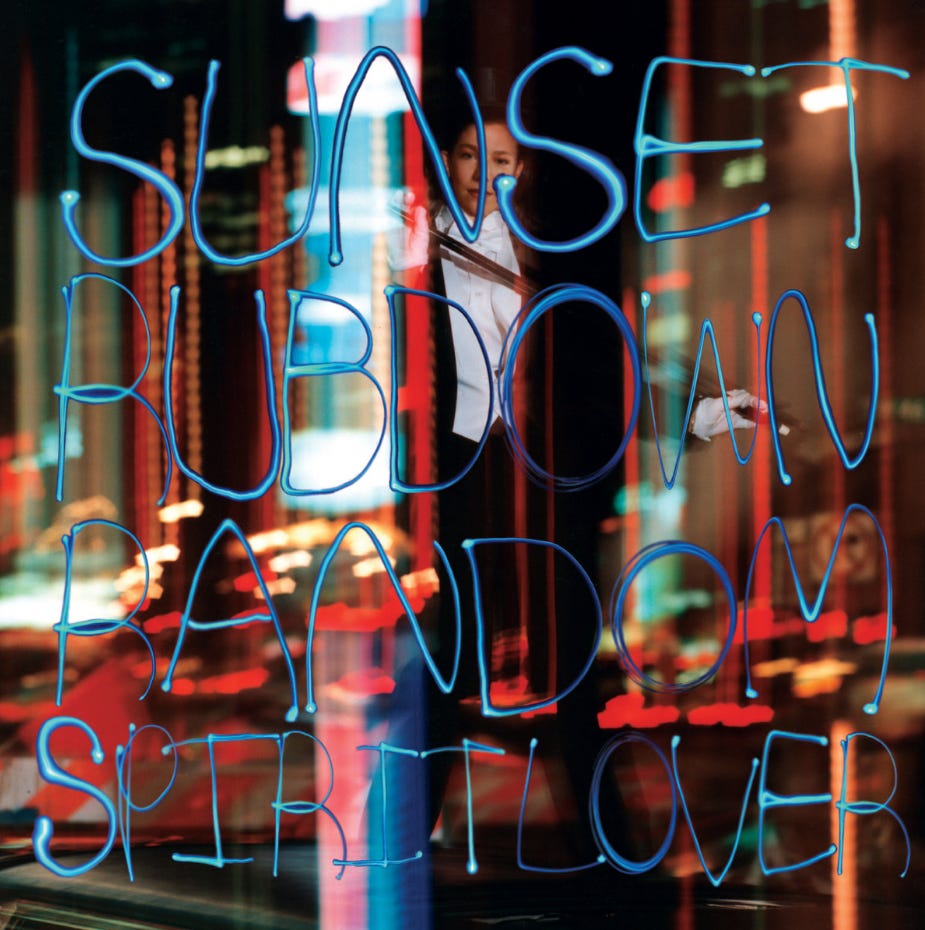
As in “Up On Your Leopard”, there is a sinister undercurrent to much of the album that suggests an evil underlying the seemingly benign proceedings, some indescribable horror right beneath the surface. This is typified by the album art. The front cover is a picture of some sort of magician, or performer, partially obscured by a curtain with superimposed neon lights, while the back cover is the same curtain, but now the magician is gone. In her place is Krampus, the demonic counterpart to St. Nicolas in European folklore who punishes misbehaved children by stealing them away to some unknown torment.
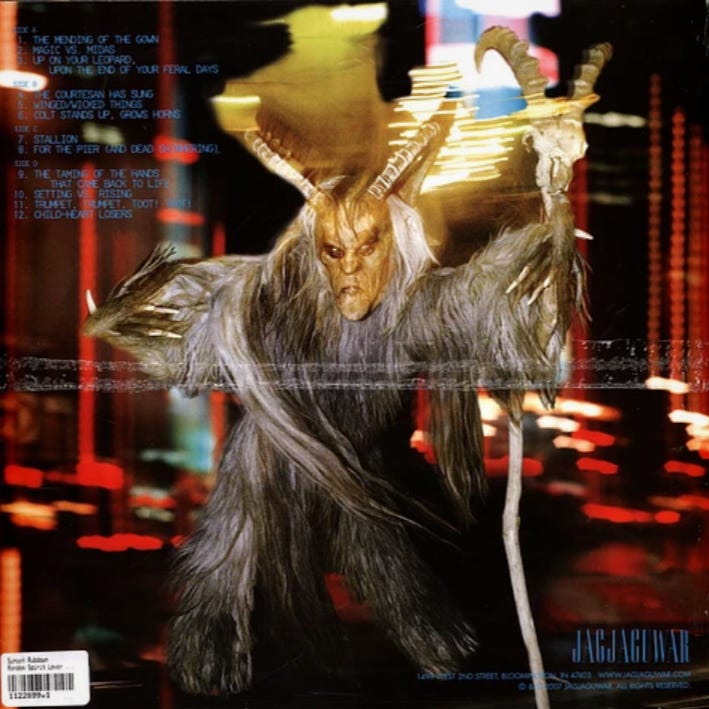
This juxtaposition between magic and childlike, playful innocence and the shapeless stuff of nightmares is Krug’s calling card on Random Spirit Lover. He uses minor keys and dissonance to great effect throughout, so that even during the most triumphant and joyful moments there is a sense of unease, something not quite right. Take for instance “The Courtesan Has Sung”. After opening with a repeated verse of multi-tracked chanting Krugs accompanied by tribal drums, the song explodes into a stunning climax of shimmering guitars and a choir-like refrain. But the euphoria is undercut by Krug’s pounding descending piano chords, which give what should be a completely triumphant moment a sense of unresolved tension. This sense of unease boils over in “Colt Stands Up, Grows Horns”, an interlude sung by Wynne Ingr. “I followed the trail you left in the snow/ Picked up your footsteps and made them my own…/ And you twist up the land until the snow turns to sand/ And I can’t find the trail back home” she whimpers, eerie music soundtracking the doomed journey and collapsing in a cascade of atonal synths and pounding drums before resolving on the plaintive, opening minor chord of “Stallion”.
Lyrically, much of the album deals with perceived notions of reality and truth. “There’s a breech in the hull where the truth and the water’s too deep to prove” Krug sings on “The Mending of the Gown”. “Do you call a setting sun a sun rising?” he asks on “Setting vs. Rising”. “Well I say it’s just smoke/ So you say it’s the hair of ghosts/ So I say it’s the white hair of Poseidon/ Ebbing in the tide of some dead sea” he reasons on “Winged/Wicked Things”. His lyrics throughout the album highlight the shifting, uncertain nature of reality, the feeling that if you look at something close enough, you will find something quite different than you initially glimpsed.
In addition to asking general questions about the nature of reality, Krug uses the artifice of performance art as a metaphor for the way we hide our real selves from others, “It’s an act, I think she’s just pretending” (“The Mending of the Gown”). He condemns the lies we offer in place of our perceived weaknesses, the way we appropriate aspects of others’ personalities to replace our faults. Krug masterfully does this by narrating a series of exchanges and interactions between himself and other musicians and actors, mostly women (Maggie, Sam, Nadia, Amber), probing their (and sometimes his own) artistic choices and understanding of their craft. On “The Taming of the Hands That Came Back to Life” he asks a series of pointed questions, the guitar, synth, and drums stutterstepping beneath: “Do you think the second movement has too many violins?”, “She said my sails are flapping in the wind/ I said, can I use that in a song/ She said I mean the end begins/ I said, I know, can I use that too?”, “Will you live in the physical world/ With the sun setting low and the shadows unfurled/ Can you live with the way they make you look unreal?”.
On “Trumpet, Trumpet, Toot! Toot!” his tone reaches a fever pitch, and he frantically demands some forthrightness: “Were you the leopard, or the virgin, or the child in a grown man’s beard/ All out of place and hanging off his face by the time the audience cheered”, shrieks of distorted guitar, feedback, and staccato keys and drums careening around his frenzied accusation. “The part of the virgin has been taken.../ If you’re the virgin, then I’m the stand-in” he sings, seemingly having come to terms with and accepted his true identity. But the last lyric on the album closer, the beautiful acoustic guitar lullaby “Child-Heart Losers”, suggests the object of Krug’s inquisition (perhaps himself) hasn’t come clean and is still concealing themselves with dishonest embellishments and masks: “Why so many many many many many violins?”, Krug and Wynne Ingr sigh, leaving the question open-ended, unresolved.
Thus ends a mammoth album, a grand accomplishment by Krug and his band. This moment of perfection would turn out to be short lived, as Krug kept Sunset Rubdown together for only one more album before disbanding the group in pursuit of his restless creative muse.1 He remains one of the most prolific, singular voices in music today. With Random Spirit Lover, however, he distilled his creative vision into its pure essence, a singular artistic statement. For sixty glorious minutes, we can experience what it’s like to be inside the head of a mad genius. Krug’s world is a strange, magical, and scary place. I wouldn’t want to live there; staring in through this immaculately conceived and executed window is thrilling enough.
Their return album last year, Always Happy to Explode, was one of my biggest disappointments of the year.